Operational Resilience
Map every service to the assets it runs on, and see what really breaks.
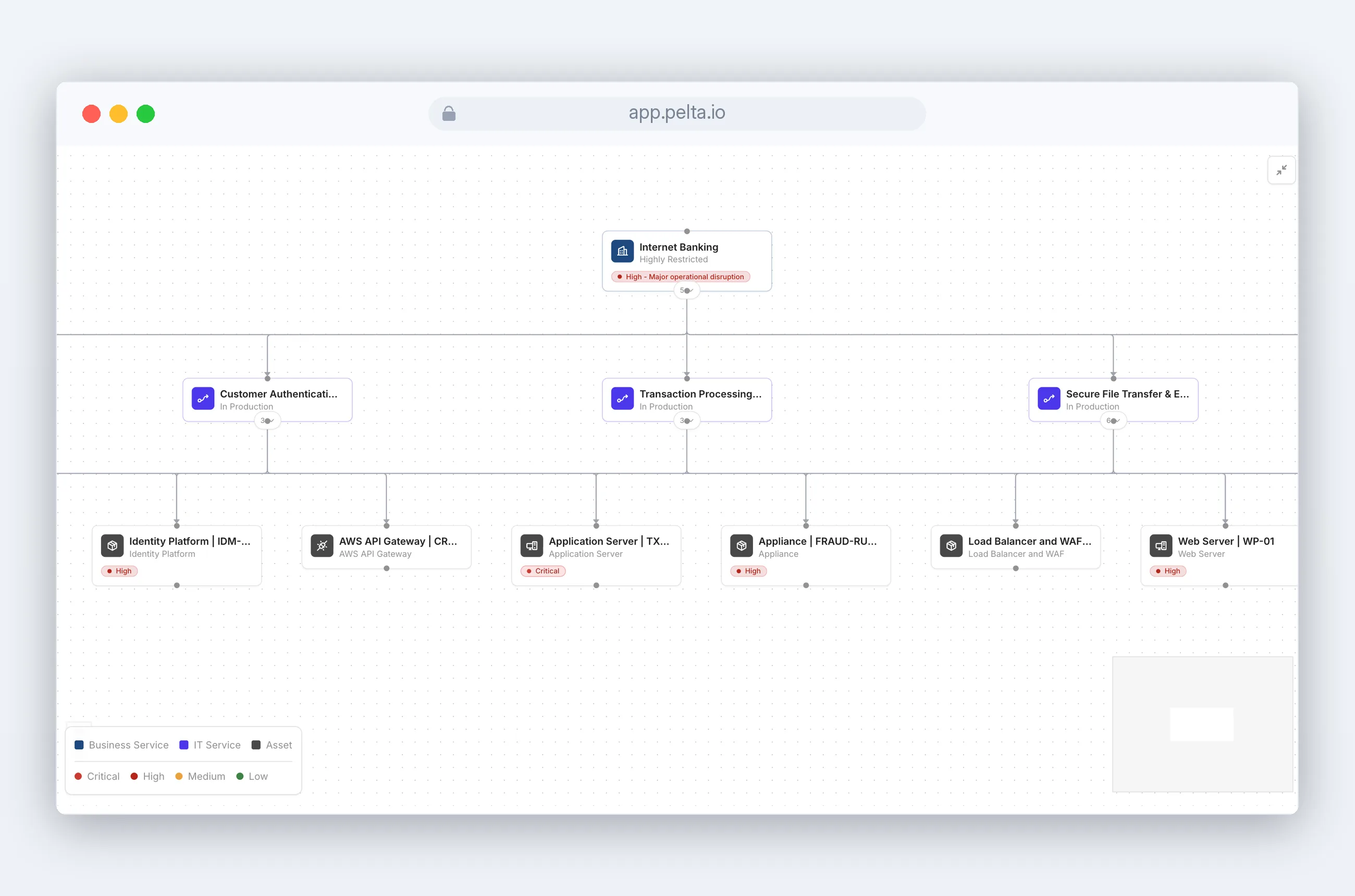
Identify your important business services, let AI map the full chain from business service to IT service to asset, catch the RTO/RPO anomalies no one else spots, and trace every incident back through the chain to invest where it matters.
- AI-mapped Business → IT service → Asset dependency chains
- RTO/RPO anomaly detection across the whole chain
- Incident tracing and a historical view to target investment with data
What's inside Resilience
See what actually breaks, from business service to asset
Map the real dependency chain behind every critical service, catch the recovery anomalies no one else spots, and turn every incident into data you can invest against.
Identify your important business services
Resilience starts by naming the services the business actually depends on (Internet Banking, payments, onboarding) and capturing what recovery means for each: RTO, RPO, impact tolerance and criticality. Everything else hangs off these.
- Define important (or business-critical) services in one place
- Capture RTO, RPO, impact tolerance, availability and data class
- A single, board-ready view of what the business can and can't tolerate
Important business service
Internet Banking
- RTO
- 2 hours
- RPO
- 15 minutes
- Impact tolerance
- 2 hours
- Availability
- 99.9%
- Data class
- Highly restricted
- Criticality
- Critical
From business service to IT service to asset, automatically
A business service runs on many IT services, and each IT service runs on many assets. Pelta builds that full dependency chain for you (reading your process details, network diagrams and asset data with AI) and renders it as a visual map. Then it catches what humans miss: any asset or IT service whose RTO or RPO is longer than the business service it supports, which is logically impossible and quietly fatal to recovery.
- AI maps Business → IT service → Asset from your process docs and network diagrams
- An interactive visual map of the whole dependency chain
- Automatic RTO/RPO anomaly detection, flags illogical, unrecoverable links
Business service
Internet Banking
RTO 2h · RPO 15mIT service
Payment processing
RTO 1h
IT service
Web front-end
RTO 30m
IT service
Auth service
RTO 1h
Trace every incident, then invest with data
When something breaks, Pelta maps exactly where it happened and what failed, which asset, which IT service, which business service was hit. Over time that builds a factual history of what actually causes disruption, so investment goes where the data points, not where it merely feels risky.
- Trace an incident through the chain: failed asset → impacted IT service → degraded business service
- A historical view of what really drives business-service disruption
- Prioritise resilience spend with evidence, not gut feel
Incident · 14 Aug 2026
Internet Banking degradedPayment gateway
Failed
Payment processing
Impacted
Internet Banking
Degraded
Top disruption causes · last 90 days
- Payment gateway3 incidents
- Load balancer1 incident
- Auth service1 incident
Invest where the data points, not where it feels risky.
Share
Process docs, network diagrams
AI maps
Business → IT → Asset
Visualise
Interactive chain map
Validate
RTO/RPO anomalies flagged
Trace
Incidents mapped to the chain
Part of one unified platform
Share evidence and context across every module, adopt the rest whenever you're ready.
Agentic GRC
Run compliance across frameworks, policies, risk and registers in one module, with agentic AI drafting client-specific policies and procedures, and a crosswalk that reuses your existing controls and evidence to auto-complete the overlap when you add the next framework.
Explore GRCAgentic Third-Party Risk
Continuously monitor your vendors across the deep and dark web, keep every contract and certification current, and run AI-scoped assessments end to end on the platform, vendors complete everything, evidence and all, in Pelta.
Explore TPRMSee Resilience on your program
Identify your important business services, let AI map the full chain from business service to IT service to asset, catch the RTO/RPO anomalies no one else spots, and trace every incident back through the chain to invest where it matters.